Leadership crisis in Nigeria: myth or reality
A very genuine question: Is Nigeria really the giant of Africa?
B
Benedict Nwadike
Ogbako Umunwanyi Igbo Worldwide Foundation
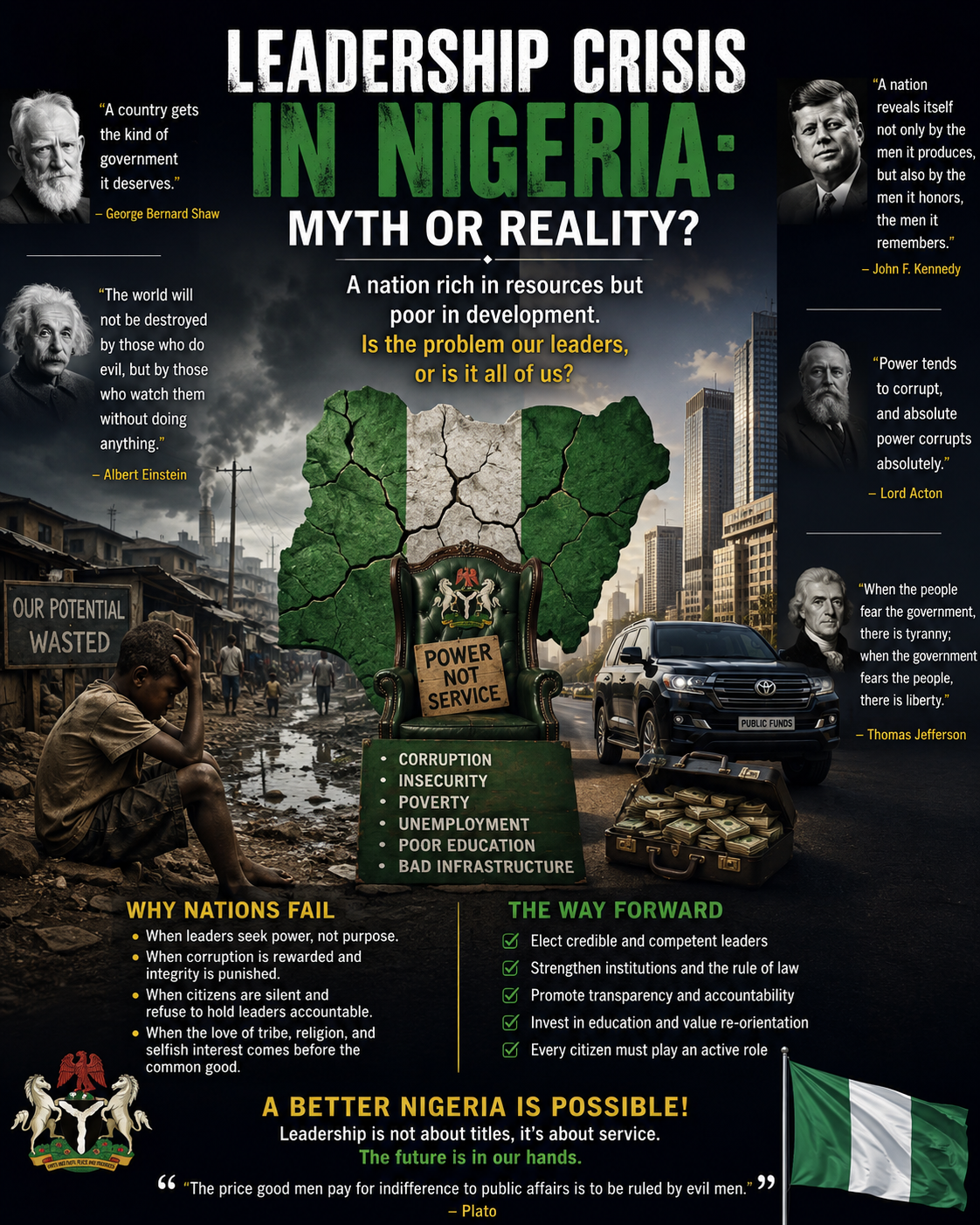
Nigeria, often referred to as the "Giant of Africa," is blessed with abundant natural resources, a vibrant population, and immense economic potential. Yet, despite these advantages, the country continues to struggle with poverty, insecurity, unemployment, inadequate infrastructure, and social unrest. This has led many citizens and observers to ask an important question: Is there truly a leadership crisis in Nigeria, or is it merely a myth?
To answer this question, it is necessary to understand what leadership means. Leadership is the ability to guide, inspire, and direct people toward achieving common goals. Effective leadership requires vision, integrity, accountability, competence, and a commitment to the welfare of the people. When these qualities are absent, governance suffers, and development becomes difficult.
Many Nigerians argue that the leadership crisis is a reality. They point to years of corruption, mismanagement of public resources, poor policy implementation, and the failure of many leaders to prioritize the needs of citizens. Despite generating significant revenue from oil and other resources, millions of Nigerians still lack access to quality healthcare, education, electricity, and employment opportunities. These challenges have often been linked to poor leadership at various levels of government.
Furthermore, insecurity remains a major concern. Issues such as terrorism, banditry, kidnapping, and communal conflicts continue to threaten lives and property across different parts of the country. Critics argue that effective leadership should provide security, stability, and an environment where citizens can thrive. The persistence of these problems strengthens the argument that Nigeria is experiencing a leadership crisis.
However, some people believe the issue is more complex than simply blaming leaders. They argue that citizens also play a role in governance. Electoral malpractice, ethnic favoritism, political apathy, and the tendency to celebrate wealth without questioning its source contribute to the nation's challenges. According to this view, leadership reflects the values and attitudes of society. Therefore, the problem is not only a leadership crisis but also a followership crisis.
There is some truth in both arguments. While many leaders have failed to meet public expectations, sustainable national development requires active and responsible citizens. Good governance thrives when leaders are held accountable and when citizens participate actively in democratic processes. A nation cannot progress if leaders neglect their responsibilities or if citizens fail to demand accountability.
The way forward lies in promoting transparency, strengthening institutions, encouraging civic education, and electing competent individuals based on merit rather than ethnicity, religion, or political loyalty. Young people must also become actively involved in leadership and governance, bringing fresh ideas and a commitment to national development.
In conclusion, the leadership crisis in Nigeria is more reality than myth. The nation's persistent developmental challenges provide evidence that leadership has often fallen short of expectations. Nevertheless, solving this crisis requires collective responsibility from both leaders and citizens. Nigeria's future depends on building a culture of integrity, accountability, and service, where leadership is viewed not as an opportunity for personal gain but as a commitment to the common good.
> **"The price good men pay for indifference to public affairs is to be ruled by evil men."** — Plato
A better Nigeria is possible when both leaders and citizens work together to build a nation founded on justice, accountability, and genuine service to the people.
Tags:
Politics
B
Written by
Benedict Nwadike
Ogbako Umunwanyi Igbo Worldwide Foundation — Empowering women and children through community-driven programs.